
Wealth management runs on data. But the infrastructure behind that data hasn’t kept pace with the industry it serves.
Positions, transactions, balances, cost basis, performance, fees. It flows in from custodians, private banks, fund administrators, alternative asset managers and digital asset providers, powering everything from client reporting and compliance to the AI applications and agents now entering production.
For much of the industry’s history, that data came from a small number of domestic sources. Today, clients hold assets across countries, currencies and asset classes. Private markets make up a growing share of portfolios. And the systems consuming financial data increasingly include AI and autonomous agents alongside people.
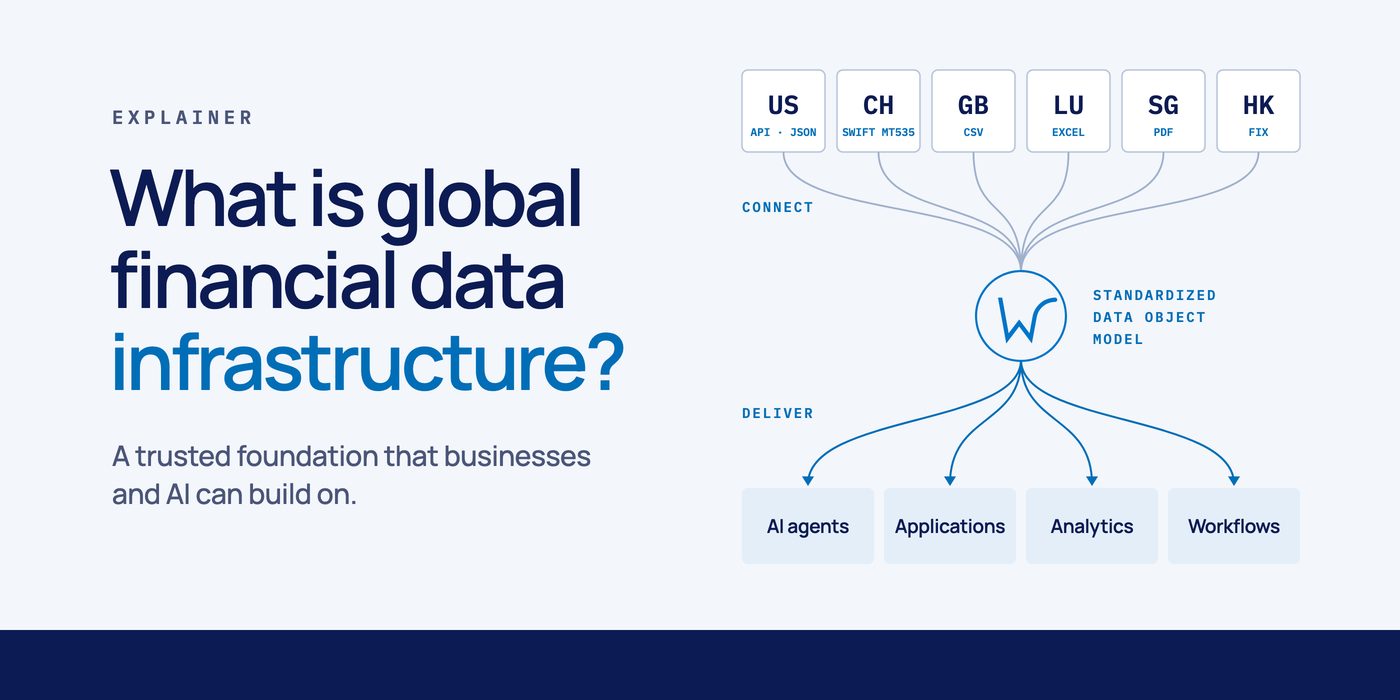
Global financial data infrastructure is the foundational layer that connects, unifies, and delivers financial data across banks, custodians, asset classes, currencies, and jurisdictions worldwide. It has four essential jobs.
Connect
The first job is access. That means direct connections to the institutions where assets actually sit: U.S. custodians and broker-dealers, Swiss and European private banks, regional custodians in Asia and the Middle East, and providers of private market and digital assets. Each delivers data in its own format, on its own schedule and at its own level of quality.
Validate and normalize
Raw feeds aren’t ready to use. A position reported by a bank in Geneva and the same type of position reported by a custodian in New York may look nothing alike. Infrastructure checks data for completeness and errors, then transforms it into consistent, standardized financial objects, regardless of where it originated.
Reconcile
Data from different sources needs to be consistent and trustworthy. Holdings must align with transactions. Cash movements must match balances. When something doesn’t line up, discrepancies need to be identified and resolved. Infrastructure that supports reconciliation reduces the manual effort required to maintain accurate financial records.
Deliver
Finally, trusted data has to reach the systems that use it: portfolio management systems, reporting tools, CRMs, data warehouses, analytics platforms and AI applications and agents. Modern infrastructure delivers standardized, context-rich financial data through APIs and other integration methods, without requiring custom work for every application.
The freedom to innovate
Most wealth technology treats data as a feature of an application. The data lives inside the platform, shaped by that platform’s needs, and moving it elsewhere can be difficult. Independent infrastructure takes the opposite approach. It sits underneath the applications, serves multiple systems and isn’t tied to any single technology provider or ecosystem.
That distinction matters more every year. Firms change systems, acquire businesses with different technology and adopt new tools, including AI, at a pace that would have been unthinkable a few years ago. An independent data layer means those decisions don’t require rebuilding the foundation.
Global by design
Domestic data infrastructure was built around domestic assumptions: a few large custodians, standard account structures, and one currency. Those assumptions break down as soon as a client has an account in Zurich or a fund commitment in Luxembourg. Global infrastructure is designed for multiple jurisdictions, currencies, formats and asset classes from the start, not added later.
And as AI agents begin analyzing portfolios, monitoring risks and automating financial workflows, the need for trusted, standardized global data becomes even more important.
That’s what WealthArc builds. We connect to more than 230 banks, custodians and financial institutions across 24+ countries and jurisdictions spanning 5 continents, including more than 100 in the U.S., transforming fragmented information into standardized, reconciled and AI-ready financial data that wealth managers, technology platforms, financial institutions and AI companies can build on.
Our mission is to make global financial data accessible, usable and actionable for humans, AI and autonomous systems.
The applications will keep changing. The foundation underneath them is what makes what’s next possible.
Simply put, global financial data infrastructure transforms fragmented financial data into a trusted foundation that businesses and AI can build on.


